
Chimneys repointed, rebuilt or taken down
Stacks take more weather than anything else on a house and they are usually the last thing anyone looks at. Repointing, new flaunching, lead flashings, pots and cowls, partial rebuilds and full removals below the roof line with the roof made good after. All of it off a scaffold, all of it with a written estimate first.
Every chimney repair, covered
Repointing and flaunching
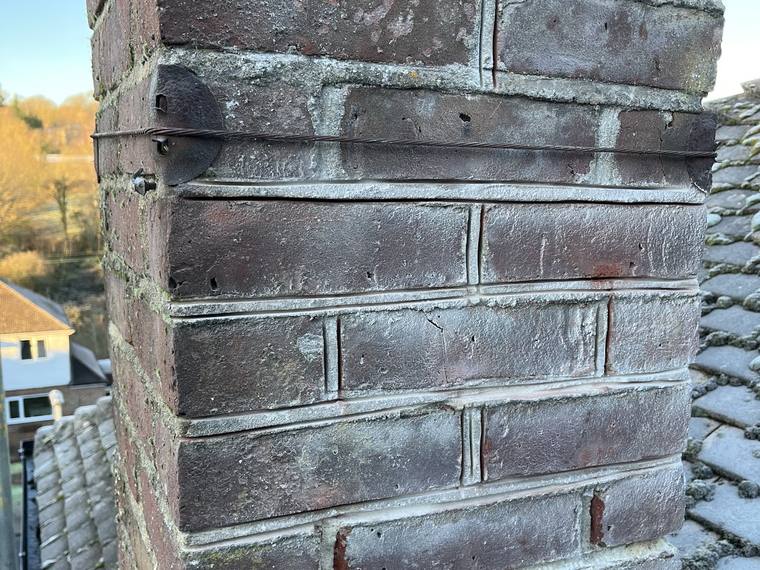
Perished mortar raked out and repointed in a mix suited to the brick, and the flaunching, the mortar bed the pots sit in, cut back and recast so it sheds water instead of holding it. Cracked flaunching is behind a surprising number of damp chimney breasts.
Lead flashings done properly
Front apron, step flashings, soakers and back gutter in the right code of lead, chased in and wedged rather than smeared over with mastic. Cement fillets crack every winter. Lead does not, which is why it is still the answer a hundred years on.
Partial and full rebuilds
Where the brickwork above the roof has gone too far, the stack is taken down to a sound course and rebuilt, reusing the original bricks where they are worth reusing and matching where they are not. The Victorian terraces in Redhill and Reigate have plenty of stacks worth keeping.
Removal and making good
Redundant stacks taken down to below the roof line, the hole tiled back in with matching covering and the roof structure supported properly. Done right, you cannot tell there was ever a chimney there. Done badly, it is a leak waiting for the first easterly.
Asked and answered
How do I know if my chimney needs repointing?
Look for mortar you can rake out with a key, missing joints on the weather side, and a damp patch on the chimney breast inside that comes and goes with the rain. From the ground, binoculars tell you more than you would think. From a scaffold we can tell you exactly, and whether it is a repoint or a rebuild.
Can you remove a chimney we never use?
Yes, and it is a common job. Most people take it down to just below roof level and have the roof closed up, which removes the maintenance without touching the breast inside the house. If you want the breast removed as well that is structural work and needs a builder and, usually, a calculation.
Should the chimney be capped if the fire is gone?
A capped pot or a vented cowl keeps the rain out while still letting the flue breathe, which stops damp and condensation in a disused flue. Sealing a flue completely without ventilation is how you get a damp, musty chimney breast, so we fit vented caps rather than blanking it off.
Will the new brickwork match the old?
We match as closely as reclaimed or current stock allows, and on a partial rebuild the original bricks are usually cleaned and reused for the visible faces. Mortar colour is matched too. On a hundred year old stack a perfect match is not always possible, and we will say so before starting rather than after.
Is scaffolding needed for chimney work?
For anything more than a quick look, yes. A stack needs a scaffold with a proper working platform around it, and often a chimney lift. It is on the written estimate up front, and it is the reason chimney work costs what it does.
Chimney Repairs across east Surrey
Based in Smallfield, just outside Horley, so most of the work is within half an hour of the yard. If your postcode is not on the list, give us a ring anyway.
Planning a chimney repair?
Free written estimate, and nothing to pay until you are happy with the job.